
Verdict: One strong gag, varied one element at a time, fills a week of Shorts on a free plan: seven clips for about 150 of the week's 350 Google Flow credits.
Best for: Small Shorts creators on Flow's free plan who would rather deepen one proven idea than brainstorm seven.
Not for: Anyone expecting seven unrelated, cinematic clips — this is a family of variations, not seven premieres.
This article stretches the daily routine from our Google Flow beginner workflow across a whole week. It is built on the only two clips we have actually generated: a Fast-mode cow clip from October 31, 2026 and a Lite-mode baby-goat clip from November 1, 2026. The worked week below uses those two as Days 1 and 2; Days 3 to 7 are planned examples — the prompts we would generate next, not videos that exist. We would rather label the template honestly than fake a finished week.
The core method: one gag, one change at a time
Coming up with the gag is the expensive part. Every new idea needs drafts before you know whether its action even works — and our tests showed the action is exactly where AI video is weakest. A variation reuses a gag whose ending already landed, so most of the prompt is pre-tested. The rule: change exactly one element per Short.
- Animal — same theft, different thief: the goat steals the hat instead of the cow.
- Prop — swap the hat for a bucket, a bell, a feed sack.
- Setting — the same gag at sunset, in the rain, in a different field.
- Ending — keep the setup, change the final frame: a chase instead of a stare, a second animal reacting.
One change keeps the family recognisable — the same joke, retold — while each Short still stands alone. Change two elements and you are testing a new idea at full price again.
The two real clips this week is built on
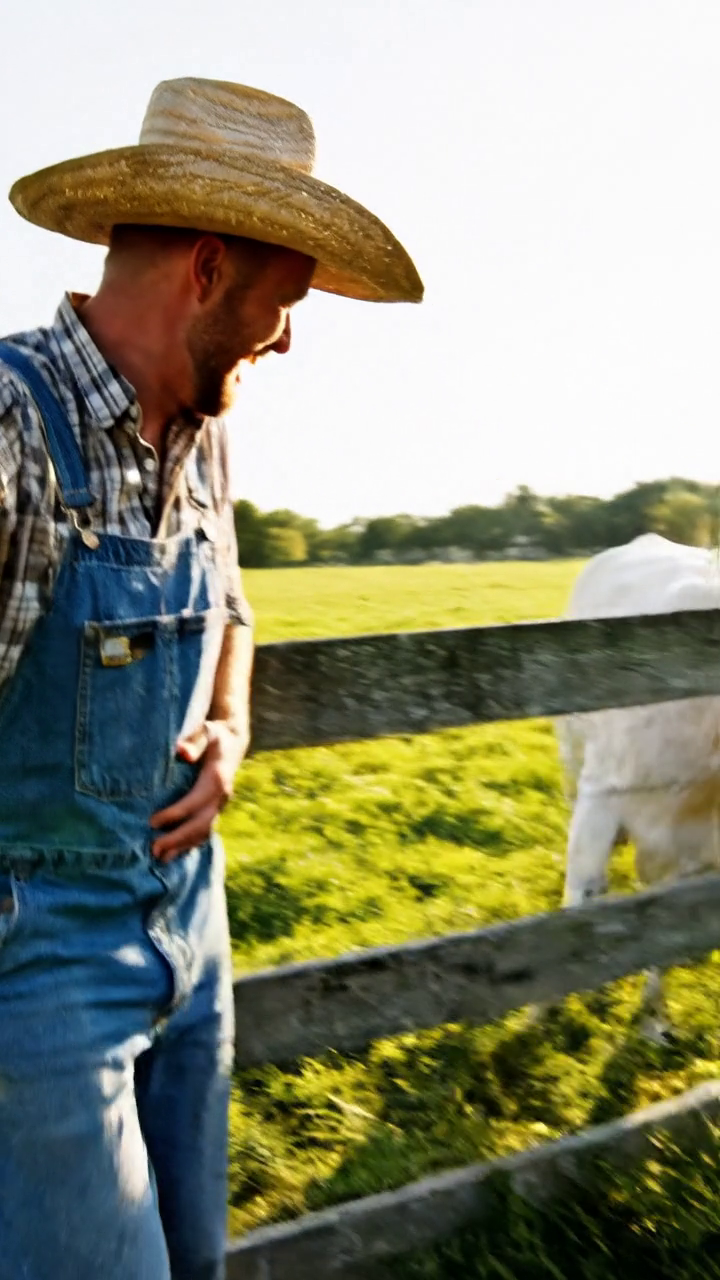
Day 1's clip (Fast, 20 credits, October 31): a white cow stretches over a fence to steal the straw hat off a laughing farmer's head, then trots away wearing it. The end state landed exactly as prompted. The middle did not: the hat never visibly leaves the farmer's head — the frame below catches him mid-laugh, still hatted — so the steal itself morphs. Lesson one: endings are reliable, mid-action physics is not — so we build variations around end states.
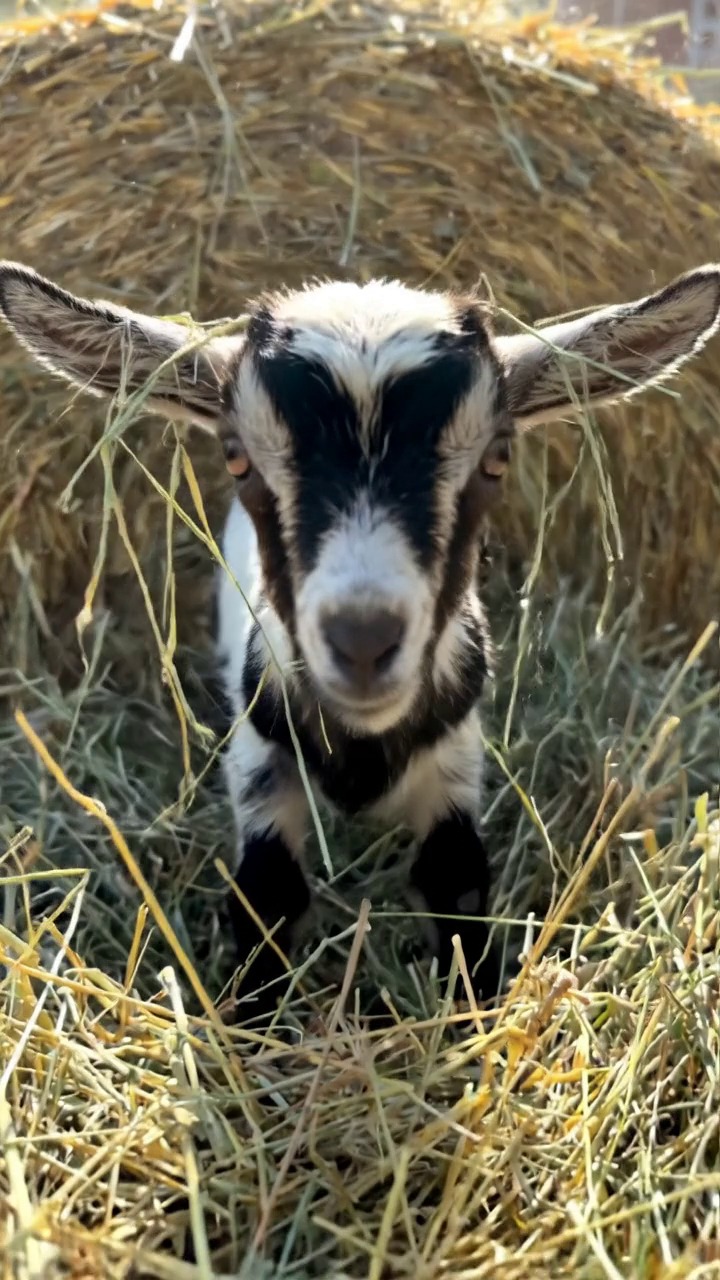
Day 2's clip (Lite, 10 credits, November 1): a baby goat hops onto a round hay bale, tumbles into loose hay, and pops its head up into a full-frame close-up. It followed the prompt closely, beat for beat — at half the credits. Lesson two: a Lite draft that passes is not a draft — it is the final, and publishing it as-is saved the 20 credits a Fast remake would have burned.
The worked week
Seven days from the same farm-gag family. Days 1–2 are the real clips above; Days 3–7 are planned examples, written with the same five-part prompt formula from our beginner workflow.
| Day | Variation | Mode |
|---|---|---|
| 1 | The original: the cow steals the farmer's straw hat over the fence (real clip, made) | Fast final |
| 2 | New animal, new prop: the baby goat, the hay bale and the tumble (real clip, made) | Lite — the draft was the final |
| 3 | Same gag, new thief: the goat steals the hat instead (planned example) | Fast final |
| 4 | New prop: a calf knocks over the water bucket and ends up wearing it (planned example) | Lite final |
| 5 | New setting: the original hat gag at sunset, in the rain (planned example) | Fast final |
| 6 | Role reversal: the farmer steals the cow's bell and rings it at the camera (planned example) | Lite final |
| 7 | Ending-first remix: open on the cow already wearing the hat, farmer chasing behind (planned example) | Fast final |
The week's credit budget
Flow's free plan gives 50 credits a day — 350 a week — with Lite at 10 credits a clip and Fast at 20. Cost the table above:
- Drafts: one Lite draft per idea = 7 × 10 = 70 credits. Three of those drafts (Days 2, 4 and 6) double as the finals, the way the goat clip did.
- Finals: four Fast finals (Days 1, 3, 5 and 7) = 4 × 20 = 80 credits.
- Week total: 150 of 350 credits, leaving 200 in reserve — enough to re-draft every single idea once and still have change.
One caution: the daily cap still applies inside the week — credits refresh at 11:05 PM on our account, so a batching session can spend at most one day's 50 at a time.
The batching order
- Write all seven prompts in one sitting. The gag is fixed; only the changing element needs writing.
- Generate the Lite drafts in one or two sessions. At 10 credits and about a minute each, one day's refill covers five drafts; the rest wait for the next refresh.
- Run the quality gate (below) on every draft. The strongest ending leads the week.
- Spend Fast only on winners. A draft whose action morphs beyond saving never becomes a 20-credit final; a draft that passes in Lite is published as a Lite final.
- Download everything, then upload across the week. Production happens in one or two sittings; publishing stays daily, with titles and descriptions following the upload checklist in the beginner workflow.
The quality gate: three beats, every time
Every draft, real or planned, gets the same three-beats check from our workflow guide: the setup (subject readable in the first second), the action (the one thing you asked for actually happened), and the ending (a last frame worth replaying). The cow clip is the honest benchmark: its action beat partially failed — the steal morphed — but the setup and the ending were strong, so it published, flaw disclosed. A draft that fails the setup gets its prompt rewritten, not a Fast upgrade; no mode fixes an unclear first second. A draft that fails only the ending gets one Lite re-draft from the reserve, with the ending written more simply.
Honest limits
- Eight seconds is eight seconds. Every clip in this family is one gag with one ending; anything longer has to be stitched from two generations.
- The action will sometimes morph. Steals, grabs and hand-offs were the weak beat in every tool we tested, not just Flow. Variations built on end states survive this; variations built on precise action do not.
- The free plan sets the pace. 50 credits a day is a comfortable one-Short-a-day rhythm with batching — not a same-day seven-video sprint.
- A family can go stale. One change per Short keeps each clip fresh, but if a variation's numbers fall off, the honest move is a new gag — this method stretches an idea across a week, not a month.
Testing note: Based on two real generations on Google Flow's free plan — a Veo 3.1 Fast clip on October 31, 2026 (50 → 30 credits) and a Veo 3.1 Lite clip on November 1, 2026 (30 → 20 credits) — plus the daily routine in our beginner workflow. Days 1–2 of the worked week are those clips; Days 3–7 are a planning template, not made or published videos. Credit counts are as shown in Flow on those dates and can change. This post contains no affiliate links.
Comments
Post a Comment