
Verdict: A working AI video prompt is not a description of a video; it is a set of instructions a model can physically carry out in 5 to 8 seconds. Our two real test prompts prove the line: format lines and ending states were obeyed almost every time, while the mid-clip action is where all three tools stumbled.
Based on: Four hands-on generations, October 31 – November 1, 2026: one identical prompt run in Google Flow, Kling AI and PixVerse, plus one simpler prompt in Flow Lite. A small sample, honestly labelled.
Most prompt guides are written from other prompt guides. This one is written from exactly two prompts — the only two we have ever run — and the four clips they produced. One asked for four story beats and got three different kinds of failure. The other asked for one continuous movement and was followed beat for beat. Same writer, same weekend, same five-part formula behind our 25 prompts for funny animal Shorts. The difference is the wording, and the wording is the whole lesson.
The only two prompts this article uses
Prompt one — the hat-steal — ran once each in Google Flow (Veo 3.1 Fast), Kling AI (Kling 4.0) and PixVerse (V6), in our 7-tool free-tier test:
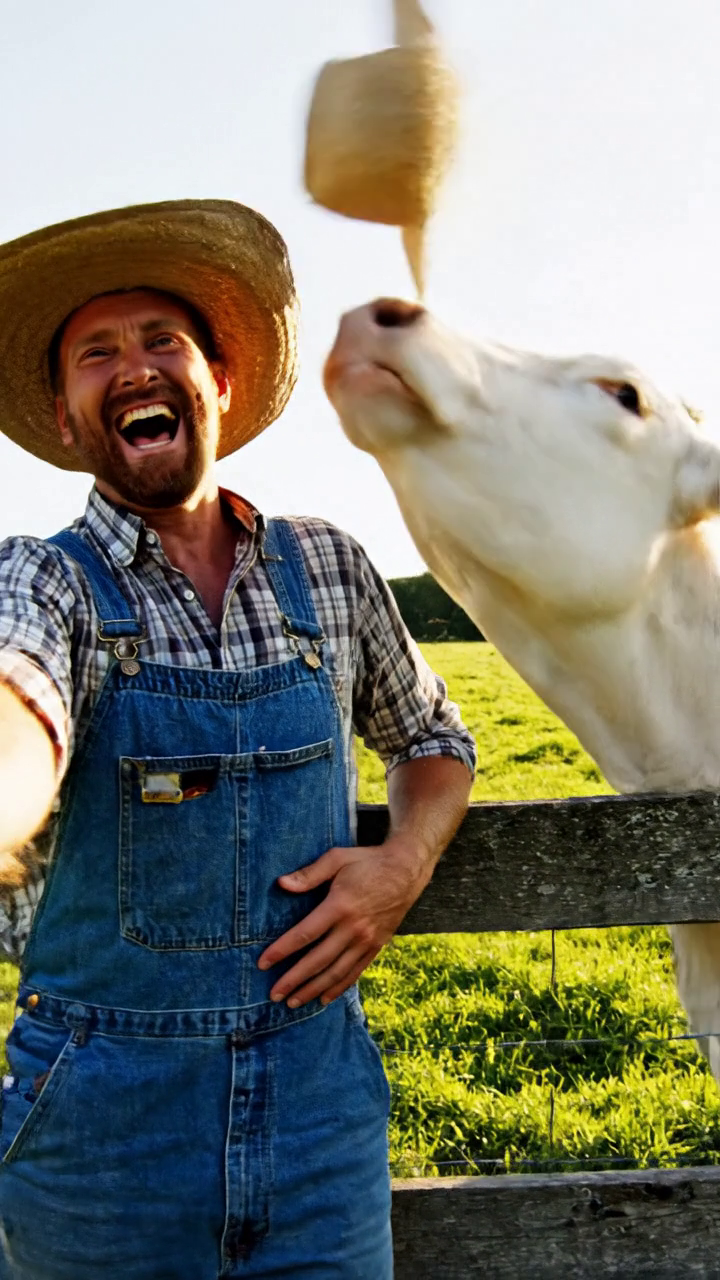
Vertical 9:16 video, realistic handheld phone footage on a sunny farm: a white cow stretches its neck over a wooden fence and steals the straw hat off a laughing farmer's head, then trots away proudly wearing it. Natural farm sounds, one continuous shot, playful mood, no text.
Prompt accuracy: Flow 3 out of 5, PixVerse 3 out of 5, Kling 4 out of 5.
Prompt two — the baby goat — ran once in Veo 3.1 Lite, and was followed beat for beat:
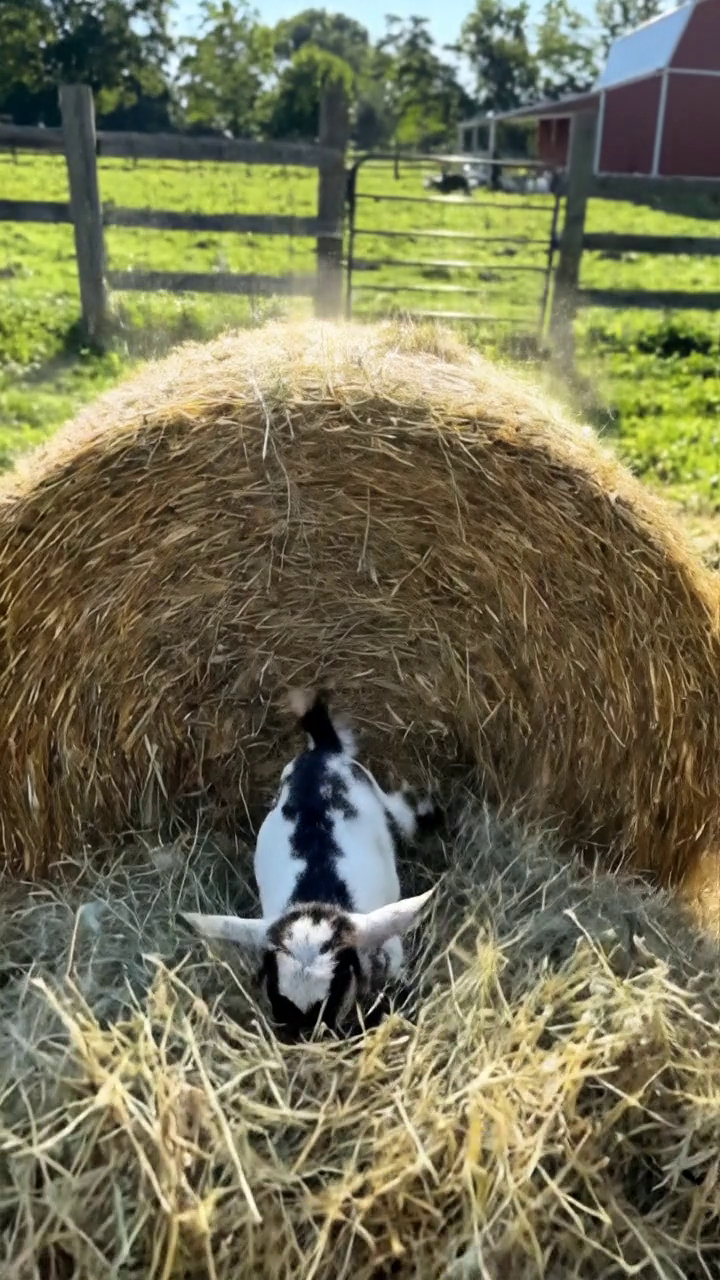
Vertical 9:16 video, realistic handheld phone footage on a sunny farm: a tiny baby goat hops up onto a round hay bale, slips, tumbles gently down into soft loose hay, then pops its head up and looks straight at the camera. Natural farm sounds, one continuous shot, playful mood, no text.
Everything below is an autopsy of these two texts.
Anatomy of the formula, part by part
Both prompts share the five-part shape from our workflow guide: format line, who and where, one action, the ending written in, style line. Here is what each part actually did.
1. Format first — and know what it doesn't cover. "Vertical 9:16 video" opens both prompts, and every clip came out vertical: 720×1280 from Flow and Kling, 576×1024 from PixVerse. But length goes unmentioned, so the tools decided it: 7.93 seconds from Flow, 5.04 from Kling and PixVerse. The prompt sets the shape; the tool sets the clock.
2. Camera language. "Realistic handheld phone footage" appears in both prompts, and the clips have that loose, shot-on-a-phone feel. In our looks-fake breakdown we raised a suspicion: handheld shake and natural light may forgive small motion flaws. It stays a suspicion — we never ran either prompt without that line, so there is no controlled comparison, and no measured quality trick to claim here.
3. Subject and setting in one breath. Straight after the colon, each prompt names who and where in a single clause: a white cow and a laughing farmer on a sunny farm; a tiny baby goat, same farm. Every opening frame in the four clips is instantly legible. But two characters means the model must track both — and PixVerse lost the farmer entirely in its later frames. Keep the cast inside that one breath tiny.
4. The action, written as movement — this is where prompt one cracked. Compare the verbs. "Stretches its neck over a wooden fence" is a physical movement, and some version of it happens in all three hat-steal clips — each frame check starts with the cow nosing at the hat brim. "Steals the straw hat off" is not a movement; it is a result. And the result is exactly what went wrong, in three different ways detailed below. Where the prompt named a motion, the models performed it. Where it named an outcome, they improvised.
5. The ending state, spelled out. "Then trots away proudly wearing it" is the most obeyed clause in prompt one: the cow ends up wearing the hat in all three clips, whatever happened in the middle. End states were easier for every model than the action. Write the last frame like a photograph caption; that is roughly how the model treats it.
6. Sound, mood, and the constraint line. Both prompts close with "Natural farm sounds, one continuous shot, playful mood, no text." All four clips came back with audio, one unbroken shot, and no captions or overlays — "no text" did its narrow job. But a prompt cannot control the package: Kling burned "KlingAI 4.0" into its free output and PixVerse burned in "PixVerse.ai" whatever we wrote, while Flow carried no visible watermark (invisible SynthID only). Watermarks — and the commercial-use terms that come with them — are set by the tool's free tier. No wording negotiates with either.
Why the goat prompt is the one that worked
The goat prompt is the hat-steal prompt with the ambition removed. One subject instead of two. One continuous movement — hop, slip, tumble is a single fall, not three scenes — instead of a prop changing owners mid-clip. And the ending is built into the movement: the head pop-up is simply where the tumble lands. On Flow's cheaper Lite model — 10 credits, about a minute — the prompt was followed closely, with one honest flaw: the tumble is brief rather than a long roll. The ask was smaller, so nothing had to be dropped.
Same words, three tools, three failure modes
The hat-steal prompt never changed by a single character, and it failed three different ways. Flow skipped the action: the hat never leaves the farmer's head — the hat the cow wears later is effectively a second hat that appears, slightly smaller than the farmer's. PixVerse morphed it: the snatch is a transition, not a grab; the farmer vanishes from the later frames and a bucket appears uninvited. Kling rushed it: all four beats happen, but the grab is a blink inside five seconds, and in the middle frame the hat sits awkwardly behind the cow's horns.
That is the deepest lesson: the prompt sets the ceiling — four beats was always too much story for 5 to 8 seconds, as our 8-second problem article works through — but the model decides the failure mode. You cannot word your way around a model's weak beat. You can only ask for less, so the weak beat is never load-bearing.
The rewrite we would run next
Here is prompt one, rewritten by our own rules: one action only — the steal; the grab written as physical movement; no separate reaction beat, because the farmer's laugh is folded into a precisely described final frame; the getaway cut — that belongs to a second clip.
Vertical 9:16 video, realistic handheld phone footage on a sunny farm: a white cow stretches its neck over a wooden fence, closes its mouth around the brim of the straw hat on a farmer's head and lifts it clean off. Final frame: the cow stands behind the fence with the straw hat sitting squarely on its own head, the farmer beside it hatless and laughing, one hand on his bare head. Natural farm sounds, one continuous shot, playful mood, no text.
We have not generated this prompt yet. It is the next test in our queue, not a result. When we run it — in Lite first, by our own draft-cheap rule — we will report what actually happens, even if the steal morphs anyway.
The mistakes, all of them ours
- Too many beats in one prompt. Reach, steal, reaction, getaway: four events in 5 to 8 seconds, and the middle ones broke in all three tools.
- Result-words instead of movement-words. "Steals" named an outcome, so Flow delivered the outcome and skipped the event.
- A second character treated as free. The farmer cost tracking the models couldn't spare: morphed around in one clip, deleted outright in another.
- Props left loosely described. The hat changed size between wearers, and a bucket nobody ordered appeared in PixVerse's field.
- An ending described loosely gets rendered loosely. "Wearing it" was obeyed — with a smaller hat.
Testing note: From our own hands-on generations on October 31 and November 1, 2026 — the identical hat-steal prompt run once each in Google Flow (Veo 3.1 Fast, 20 credits; 7.93 seconds), Kling AI (Kling 4.0, 50 credits; 5.04 seconds) and PixVerse (V6, 38 credits; 5.04 seconds), plus one Veo 3.1 Lite generation (10 credits; 7.93 seconds, the baby-goat clip). Both prompts are quoted word-for-word from those tests. No rerolls. Four generations is a small sample: field notes from real clips, not lab results. The rewritten prompt above has not been generated yet, and no results are claimed for it. Credit amounts are as shown on those dates and can change. This post contains no affiliate links.
Comments
Post a Comment