
Verdict: PixVerse's free plan is a taster in the strictest sense. Our one 5-second clip cost 38 credits, but the daily free grant is 30 — the grant cannot buy even one clip at the settings we used. And the clip you do get carries a burned-in watermark and terms that bar commercial use.
Best for: Trying the V6 model once with your signup credits, or checking whether a prompt idea reads as a clip at all.
Not for: Daily Shorts posting, or any channel you plan to monetise.
PixVerse appeared in our 7-tool free-tier test and in the head-to-head story of the same Short made in 5 AI video tools. This article is the PixVerse-only version: the free plan's real numbers, our single generation step by step, and what the fine print means if you make Shorts. Everything below comes from one hands-on test on October 31, 2026 — one generation, no rerolls.
What PixVerse is
PixVerse is a browser-based AI video generator: you type a text prompt, choose the shape and length, and its model renders the clip. We tested the default model, V6, on the free Basic plan — Google sign-in, no card entered, nothing paid.
The free plan, as we measured it
Forget the marketing page; this is what our account actually showed on October 31, 2026:
- 60 credits at signup.
- 30 credits per day as the ongoing free grant.
- 38 credits for one clip — the Create button showed the price before we committed: "Create 38".
- Free output capped at 540p, vertical 9:16 available.
- Watermark: "PixVerse.ai" burned into the top of the frame; watermark-free download is a paid feature.
- Terms: free outputs are non-commercial only (Terms of Service §4.1).
Now the arithmetic, because it decides everything else: 30 is less than 38. One day's free grant does not cover one 5-second clip at the settings we used. Our 60 signup credits bought exactly one generation and left 22 — and 22 is also less than 38, so the leftovers cannot buy a second one either. As a daily production plan, the numbers fail before quality even enters the discussion.
How our one generation went
We pasted the exact prompt used in every tool in our test — no tweaks, no second attempt:
Vertical 9:16 video, realistic handheld phone footage on a sunny farm: a white cow stretches its neck over a wooden fence and steals the straw hat off a laughing farmer's head, then trots away proudly wearing it. Natural farm sounds, one continuous shot, playful mood, no text.
Settings: text-to-video, V6 default model, 540p, 9:16, 5 seconds, audio on, multi-shot off. Generation took about 2 minutes. Then we downloaded the file and measured it rather than trusting the dashboard: 576 × 1024, 5.04 seconds, about 1.6 MB, with an audio track. One small oddity worth knowing: the player timeline called the clip 5 seconds while the site's Details panel said 6 — the file itself is 5.04 seconds. Balance after: 60 → 22 credits.
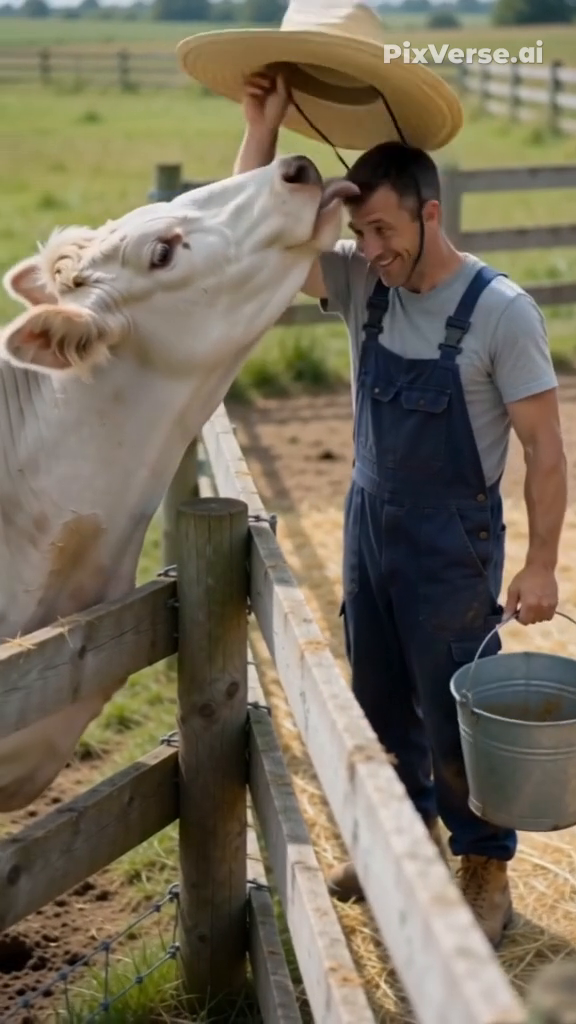
What the clip did well — and where it broke
The outline is genuinely readable. The cow noses and licks the brim of the hat while the farmer is still wearing it; the farmer smiles; then the cow is at the fence wearing the hat, tongue out, before crossing the field in it. Every story beat is present, in the right order, and the ending state — the cow wearing the stolen hat — landed cleanly. We scored prompt accuracy 3 out of 5.
Where it broke is the middle. The snatch itself is a morph, not a visible grab: the hat is on the farmer, then it is on the cow, and the one action the prompt is actually about never happens on screen. The farmer also vanishes from the later frames entirely, and a bucket appears and breaks continuity between shots. None of this makes the clip unwatchable at Shorts speed — but it is an outline of the joke, not the joke performed.
"Non-commercial" plus a watermark: what that actually means for you
PixVerse's Terms of Service (§4.1, updated October 29, 2026) restrict free-plan outputs to non-commercial use; commercial use requires paid services. Say it plainly: a YouTube channel you intend to monetise is commercial use. So the single clip your signup credits buy is not an asset you can build a monetised channel on — legally, it is a demo.
The watermark says the same thing visually. "PixVerse.ai" is burned into the top of every frame of the free output, and removing it is paid. So the free plan's real product is not publishable Shorts; it is information — a look at what the V6 model does with your idea before you decide whether the tool deserves your money. Judged as that, it works. Judged as a free channel engine, it does not.
Who it suits, and who it doesn't
- Suits: creators who want one honest look at the V6 model — the signup credits buy exactly one real test, which is enough to judge motion and prompt behaviour. Also useful for outlining: checking whether a gag reads in 5 seconds before you spend credits somewhere you can actually publish.
- Doesn't suit: daily posters (the daily grant is smaller than one clip), and monetised channels (the terms forbid it). If you need a free plan that can actually feed a channel every day, that is Google Flow — our full Flow workflow guide is built on it.
Testing note: Written from one hands-on generation on PixVerse's free Basic plan — V6, 540p, 9:16, 5 seconds, October 31, 2026 (60 → 22 credits, about 2 minutes). No rerolls; the downloaded file was measured after generation. Credit counts and terms are as shown on that date and can change. We make no claims here about PixVerse's paid plans, which we did not test. This post contains no affiliate links.
Comments
Post a Comment